
Las Vegas. June 2026. Thousands of identity professionals gathered in a city built on spectacle, and the spectacle this year was identity itself. On the one hand, you couldn't walk 2 feet without talking about or hearing someone talk about agents or digital credentials. On the other, the reality is that we are still dealing with a seriously unresolved problem in cybersecurity. To me, that paradox is the story of Identiverse 2026, and it's the story we in the industry need to stop dancing around. Yes, we are on the cusp of something transformative, but the bottom line is, our house is not in order.
The Vision: Agents and Credentials
Identiverse 2026's program was organized around four content pillars: AI Identity, Continuous Identity, Passkeys & Wallets, and Non-Human & Agentic AI Identity. Each reflected a genuine leap forward in where identity is going.
The agentic AI conversation was everywhere. As the conference described it, non-human identities now vastly outnumber human ones, and the rapid rise of agentic AI is transforming these identities from passive, deterministic processes into autonomous digital actors capable of making decisions and initiating actions at machine speed. Sessions with titles like "The Agentic AI Arms Race" and "Giving AI Models a Verifiable Digital Identity" reflected the urgency: who is accountable when an AI agent acts on your behalf? How do you govern an identity that can replicate, reason, and act independently, often without human oversight? - themes that I have been harping on.
The second dominant theme was digital credentials. Verifiable credentials, mobile driver's licenses (mDLs), and digital wallets are finally crossing from pilot to production. Today, mDLs are active in over 20 U.S. states, stored in Apple Wallet, Google Wallet, and state-specific apps, built on ISO/IEC 18013-5, the international standard that makes them cryptographically verifiable, privacy-preserving, and machine-readable. The EU's eIDAS 2.0 framework sets a mandatory acceptance deadline of November 2027 for businesses in banking, finance, and telecom to accept the European Digital Identity Wallet. The world is finally moving toward portable, cryptographically-bound, user-controlled identity.
These are genuinely exciting developments. I believe in this future. I've spent my career working toward it. And that's exactly why I feel compelled to say what needs to be said.
The Reality: Our Foundation Is Cracked
While inside we were talking about agentic identity governance and verifiable credential ecosystems, the world outside was still running on passwords, SMS codes, and secret questions about your mother's maiden name. I don't think any speaker asked anyone to raise their hand to ask them how many times they used a password in the last 24 hours, lest they would have exposed the elephant in the room. As we pivot towards the future, this is not a peripheral concern. This should be considered a five-alarm crisis.
On passwords: There are an estimated 300 billion passwords in use worldwide today. The average person manages 70 to 80 passwords. The average professional manages more than 100. And what do people do with them? Sixty percent of Americans reuse passwords across multiple accounts. Globally, 78% of people admit to reusing passwords. Three out of four passwords are considered unsafe due to reuse or simplicity. The most common password in the world continues to be "123456," found in breach datasets over 4.5 million times and crackable in under one second.
The breach data tells the same story. In June 2025, a compilation of over 16 billion login credentials was exposed across 30 datasets, the largest credential dump ever discovered online, fueled by infostealer malware. The New York State Attorney General’s Office investigation on credential stuffing highlights attempts exceeding 193 billion in a single year and their own ability to harvest more than 1.1 million credentials for 17 well known companies. I could go on and on with more examples and statistics.
The fact is our approach to identity management and authentication is failing us.
On two-factor authentication: Folks often cite SMS-based 2FA as progress. It is not. Back in 2016, a full decade ago, NIST Digital Identity Guidelines in Special Publication 800-63-3 deprecated SMS OTP, citing its susceptibility to SIM-swapping, SS7 interception, and VoIP spoofing. NIST understood this ten years ago. The final SP 800-63-4, updated in August 2025, formally classified SMS/PSTN as a "restricted authenticator", the only method in that category, making clear that its weaknesses are significant enough to require additional conditions and a migration plan.
And yet here we are. Nearly 56% of IT professionals worldwide report that their company uses SMS-based one-time passcodes for logins, and 23% view their workplace security habits as risky, with notable percentages storing passwords insecurely (45%) or using weak credentials (44%). Consumer-facing applications treat it as robust security. We knew better ten years ago and we still haven't acted.
On knowledge-based authentication: If the password situation is a slow-motion train wreck that continues to plague us, KBA is a farce we're legally required to perform in some cases. The IRS still requires knowledge-based authentication for IRS Form 8879 and 8878, the e-file signature authorization forms used by millions of Americans every tax season. And while not an explicit prescriptive mandate demanding a specific quiz, KBA is often treated as a regulatory mandate by proxy under the FTC’s Red Flags Rule (16 CFR Part 681) requiring banks and credit unions implement comprehensive Identity Theft Prevention Programs, so when a consumer calls to reset a bank password, opens a new account online, or changes an address remotely, they can use dynamic KBA infrastructure (like Equifax, Experian, or LexisNexis) to fulfill their legal obligation to clear high-risk "red flags". Beyond this, KBA remains embedded in notarization workflows, loan originations, account openings, and government portals across the country. The premise is that only the right person knows the answers. The reality is that the data broker ecosystem, which has been breached repeatedly, holds all of it. The information that KBA treats as a secret has long since become public. To make it worse, while 50% of the time the fraudsters have the right answer, 33% of the time the legitimate person forgets their information or doesn’t have it handy and is stuck.
So the bottom line is that we are legally mandating the use of authentication methods that our own standards bodies have declared insecure. And we wonder why we are in the situation we are in.
The Stakes: North Korea Is Already Inside
If you want to understand what inadequate identity infrastructure costs us in the real world, look no further than the North Korean IT worker infiltration schemes that have been quietly metastasizing across Corporate America, something that did come up in conversations at Identiverse.
One American woman, Christina Chapman, was sentenced to more than eight years in federal prison for helping North Korean IT workers gain employment at more than 300 U.S. organizations, including government agencies, using the stolen identities of 68 Americans, the Justice Department called it the largest identity-theft case of its kind. Since then, the problem has only escalated. CrowdStrike's 2025 Threat Hunting Report identified more than 320 incidents over the past 12 months, a 220% rise year-over-year, through Famous Chollina alone, in which North Koreans gained fraudulent employment at Western companies working remotely as developers. The UN estimates these schemes generate as much as $600 million annually for the regime.
These workers didn't break through firewalls. They walked in through the front door, through hiring processes that relied on resume screening, video calls, and forms of identity verification easily defeated with synthetic identities and stolen credentials. They used generative AI to forge thousands of synthetic identities, alter photos, mask their appearance during video interviews, and answer technical coding questions in real time.
This is not simply a nation-state adversarial story. This is an identity management story that touches on every simple aspect of our society. Society is build on trust. One of the most memorable lines for me came from Andre Durand’s keynote - we are in a Darwinian moment. And the truth is that we can survive and thrive if we have robust identity verification methods at the point of enrolling an employee or a consumer into a system and use continuous authentication based on privacy-preserving biometrics hardened with liveness and injection detection throughout the user journey.
The Canary in the Coal Mine: Agentic Commerce
Let’s use the recent Visa/Open AI partnership announcement as a case study.
On June 10, 2026, at the Visa Payments Forum in San Francisco, Visa announced a strategic partnership with OpenAI to embed Visa's global payment network directly into OpenAI's AI-agent-driven commerce experiences. The pitch: ChatGPT agents could independently browse, select, and purchase on a user's behalf — authorized, tokenized, and fraud-monitored through Visa's infrastructure. From my understanding, the partnership builds on Visa's Trusted Agent Protocol, an open framework launched late last year that is designed to help merchants distinguish between malicious bots and legitimate AI agents acting on a consumer's behalf. The tokenization layer ensures raw card numbers are never exposed to the agent or the merchant workflow. The authorization layer enforces spending limits before any payment clears. At the surface, it sounds great: agents as authorized economic actors, operating within defined permission scopes, with full audit trails.
But here are the identity questions that I want to know, and that I didn't hear answered satisfactorily at any point: how does everyone know who authorized the agent, and how do we know the human behind that authorization is who they say they are? Who owns the liability if the agent goes rogue? What about first-party fraud?
Forestell himself acknowledged the challenge at a conference earlier this year: "You've got an agent in the middle. The agent needs an identity. You need to secure that identity, you need to validate it, you need to collect more data in order to be able to ensure the security." That is exactly right. And it takes us right back to the foundation. Because an agent's authorization chain is only as strong as the human identity it inherits. If the human at the top of that chain was onboarded or can be reverified with a knowledge-based authentication question and a reused password, the entire agentic commerce stack is compromised at the root.
The Visa-OpenAI announcement is exciting. It is also a warning. We are racing to build agentic payment rails while the human identity layer underneath them remains fundamentally broken. That is not a knock on Visa or OpenAI. It is a call to action for all the players in the ecosystem, the issuing banks, the merchants, the processors.
Rising to the Moment: The Circle of Identity
I've been in this industry for more than 30 years. I've seen cycles of urgency followed by complacency, breakthroughs followed by slow adoption, brilliant standards followed by partial implementation. And I keep coming back to the same fundamental truth: in order to establish real security, we must persist identity across the user lifecycle regardless of service channel. This means threading the human through enrollment, device registration, authentication, account recovery, whether on the phone, in person, online or via a chat or agent. For those who have been following me, you are aware that this is what I call the Circle of Identity.
The circle of identity assures a continuous relationship between a person and the institutions, platforms, and systems that need to verify who they are, across many interactions, over the course of that relationship.
This distinction matters because most attacks do not happen at the moment of enrollment. They happen in the gaps between verification events.
Consider a sequence that is ordinary for millions of people. You open a bank account. You are verified at the time of opening. Six months later, you get a new phone. A year after that, you need to reset your credentials through the call center. Two years on, you apply for a loan. At each of those moments, the bank faces the same question: is the person in front of us now the same person who opened the account?
In most current systems, the answer is not recoverable from the architecture. The enrollment verification is not connected to the device provisioning event. The call center interaction falls back on the information that is available on the dark web for a few dollars. Each of those gaps is an entry point for a fraudster. An attacker who obtains the right information can call the bank and claim a new device. An attacker who obtains a stolen credential can step into the gap between one authentication event and the next. The verification that happened at enrollment and the identity asserted at every subsequent interaction are, architecturally speaking, unconnected. The system has no way to confirm continuity.
This is a broken Circle of Identity. A closed Circle of Identity operates differently. When a foundational biometric-anchored identity is established at enrollment, that verification becomes the persistent reference point for every subsequent interaction. A new device is not provisioned against a password or a knowledge-based question. It is provisioned against the original biometric binding. A call center interaction is authenticated against the same reference. An account recovery, a step-up authentication for a sensitive transaction, a re-issuance of credentials: all of them trace back to the foundational identity established at the beginning of the relationship.
The person does not re-establish their identity from scratch at each touchpoint. Their identity persists, carried forward by the foundational binding that anchors every interaction to the same verified human being. The gaps that attackers exploit are closed because continuity is built into the architecture.
The test of whether the Circle of Identity is actually closed is not what happens when an account is opened. It is what happens when a device is replaced, when a customer calls in, when a credential needs to be recovered, and whether any of those interactions can be traced back to the same verified person who started the relationship.
The excitement at Identiverse about agentic AI and digital credentials is fully warranted. These technologies represent the next evolution of digital trust. But they are being discussed as if we've already solved the foundational layer. We haven't.
You cannot build a verifiable credential ecosystem if a person can obtain multiple credentials under multiple identities. You cannot rely on those credentials if you cannot ensure that the person presenting them is the same person to whom they were issued. You cannot govern AI agents if you don't have strong identity assurance for the humans who authorize them or the mechanism to reverify the human along the way.
The conference theme this year was The Global Identity Imperative: The Foundation of Trust. I agree with every word. The question is whether we're willing to do what it actually takes to build that foundation, to close the circle, fix what is broken at the base, and then build upward.
The technology exists. The standards exist. The urgency is undeniable. What we need now is the will to rise to the moment.
The future of identity doesn't wait for us to get comfortable. It is already here, being claimed by AI agents, nation-state operatives, and a willing, ready and able very large army of fraudsters while we debate frameworks. It's time to slow down on the future and put our house in order before it comes crashing down in ways that will inhibit the very possibilities of progress we are so eager for.
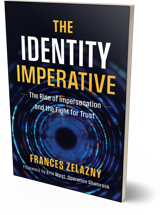
More on this in The Identity Imperative
The Identity Imperative takes these ideas further, with case studies from organizations getting identity right and the ones that did not. About the book